The Post-Summer Reset: How In-Home Personal Training Can Bring Your Energy Back

There is a strange point every August when summer technically is not over, but life starts acting like it is. Vacations slow down, school calendars come back to life, work projects pick up, inboxes get busier, and suddenly the relaxed rhythm you settled into during June and July no longer fits your actual schedule.
For a lot of people, this is also when energy starts to dip. Maybe workouts became inconsistent over the summer. Maybe you traveled more, stayed up later, ate differently, or simply gave yourself permission to loosen the routine for a while. None of that means you have to “make up” for summer, but it can make the transition back into a structured fall schedule feel harder than expected.
Then there is the bigger reality waiting just around the corner: the final stretch of the year. September brings school, sports, work deadlines, and packed calendars. October gets busy quickly. November and December add travel, holidays, family obligations, parties, and year-end work. If you keep waiting for life to calm down before getting back into a fitness routine, January can arrive before that calm week ever does.
That is why the post-summer fitness reset deserves more attention. Instead of treating August as the awkward end of summer, it can become your runway into fall. With in-home personal training, you can rebuild a realistic routine before the busiest months of the year begin without adding another commute, another crowded gym, or another complicated commitment to your calendar.
August Has Its Own Version of Burnout
Burnout is usually associated with long workweeks and packed schedules, but sometimes exhaustion shows up after a season that was supposed to be relaxing. Summer often comes with its own kind of unpredictability. Weekend trips, vacations, weddings, cookouts, kids being home from school, changing work schedules, and later evenings can make it difficult to maintain the routines that usually keep your week feeling grounded.
By August, many people are ready for structure again but do not necessarily feel energized enough to create it. You may find yourself saying that you will get back to the gym once school starts, once work settles down, once the weather cools off, or once the calendar looks normal again. The problem is that fall rarely arrives with an empty calendar waiting for you.
A better approach is to treat this transition as a gradual reset rather than an overnight transformation. You do not have to jump from vacation mode into an extreme workout schedule. Reestablishing two or three realistic training windows, getting back into strength work, and putting movement back on the calendar can create momentum without making your fall routine feel like another full-time job.
This is where at-home personal training can be especially useful. Instead of trying to rebuild a fitness routine around a gym, your training is built around the life you are actually returning to.
The Shift From “Summer Mode” to Q4 Happens Fast
The end of summer can feel like flipping a switch. One week you are mentally planning your next weekend at the lake or beach, and the next you are looking at school calendars, football schedules, work travel, fall events, and everything that needs to happen before the end of the year.
For professionals, this is often when the pace of work changes too. Projects that slowed during vacation season start moving again, meetings multiply, and companies begin looking toward fourth-quarter goals. Hybrid and remote workers may find themselves spending longer stretches at the computer, while parents are suddenly fitting work around drop-offs, pickups, homework, practices, and evening activities.
Your fitness routine has to survive that version of your life, not the one you had in July.
Someone working from home in Birmingham may have a 45-minute opening between meetings but no time for a round-trip drive to the gym. A parent in Franklin or Brentwood might have exactly one quiet window between school drop-off and the workday. Someone in Huntsville or Madison may have a demanding project schedule that makes a rigid evening fitness class nearly impossible.
Those are not motivation problems. They are logistics problems, and logistics matter when you are trying to build consistency.
Your Energy Problem Might Actually Be a Friction Problem
It is easy to assume that you need more discipline when workouts start disappearing from your schedule. In reality, sometimes there are simply too many steps between deciding to exercise and actually exercising.
Think about a traditional gym trip. First you have to find the time, pack what you need, drive there, park, check in, possibly wait for equipment, complete the workout, and drive home. Add rush-hour traffic or a busy family schedule and a workout that looked manageable on paper can suddenly consume a much larger portion of your day.
Every extra step creates another opportunity to decide, “I’ll do it tomorrow.”
In-home personal training removes much of that friction by bringing the training session into your existing environment. Your home, garage, driveway, apartment fitness center, patio, or another appropriate space can become your training area for the day. Rather than spending your limited fitness time getting somewhere, more of that time can actually be spent moving.
For busy adults, that difference matters. A fitness routine becomes far easier to repeat when it does not require an elaborate sequence of events before the first exercise even begins.
Stop Trying to Go Back to Your Old Routine
One of the biggest mistakes people make after summer is trying to recreate exactly what they were doing before summer started. Your September schedule may look nothing like your April schedule, so there is no reason your fitness routine has to look the same either.
Maybe you used to work out at 5:30 p.m., but now that hour belongs to soccer practice. Maybe you trained before work, but school drop-off has changed your morning. Maybe you previously had time for hour-long workouts but now have several smaller openings throughout the week.
Instead of seeing those changes as obstacles, use them as information. Your current schedule tells you where fitness can realistically fit. A personal trainer that comes to your home can help you make use of those openings rather than forcing your life into a prebuilt workout schedule.
That could mean a focused strength session before your first meeting, training after school drop-off, exercising over lunch while working remotely, or fitting a session into the late afternoon before the evening rush begins. The best routine is not necessarily the one that looks most impressive. It is the one you can still follow when October gets busy.
Strength Training Makes Sense When Time Is Limited
When your schedule is packed, a well-designed workout matters more than trying to cram every possible exercise into one session. Strength training can make efficient use of your available time because a program can incorporate compound movements that challenge several areas of the body within the same workout.
A HOMEFIT trainer may use exercises involving squats, hinges, presses, rows, lunges, carries, core stability, mobility, and other movements depending on your goals and fitness level. Portable tools such as dumbbells, kettlebells, resistance bands, mini bands, exercise sliders, and bodyweight exercises can create plenty of variety without requiring an entire commercial gym.
This is also where functional strength training becomes particularly relevant. Fall is not just a season of sitting at a desk. It is carrying sports bags, hauling groceries, lifting luggage, working in the yard, walking through football stadiums, traveling, keeping up with children, and navigating long days that can demand more physical energy than we realize.
Training for strength that shows up in everyday life can make fitness feel more useful. Instead of exercising simply to check a box, you are building capacity for the things you actually spend your week doing.
The 30-to-45-Minute Window Is More Valuable Than You Think
One of the habits that can derail a post-summer reset is believing a workout only matters when you have a large block of free time. If your idea of exercise requires an uninterrupted 90-minute window, busy season can make it nearly impossible to begin.
The better question is: What time do you consistently have?
A focused session does not have to include every possible fitness component at once. One workout might emphasize lower-body strength and core stability. Another can focus more heavily on upper-body strength, mobility, or conditioning. Over the course of a well-planned week, those sessions can work together rather than forcing everything into one marathon workout.
That mindset is especially helpful during fall because schedules tend to change. A normal Tuesday can become a school event, late meeting, flight, football game, or last-minute obligation with very little notice. A fitness routine built around realistic windows has a much better chance of surviving those changes.
The goal of your post-summer reset is not to create the biggest workout schedule possible. It is to rebuild a pattern you can keep.
The “September Reset” Works Better Than Waiting for January
January gets most of the attention when it comes to starting over, but the transition into fall has many of the same ingredients. Schedules become more structured, routines return, and people naturally begin thinking about how they want the remainder of the year to look.
That makes August and September a surprisingly useful time to reassess fitness goals.
Waiting until January means moving through the entire fall and holiday season without addressing the routine that already is not working. Starting now gives you time to experiment. Maybe mornings turn out to be unrealistic, but lunchtime works perfectly. Maybe three workouts sounded ideal, but two structured sessions plus independent movement fits your week better. Maybe you discover that training at home eliminates the exact obstacle that has made previous fitness routines difficult to maintain.
By the time the holidays arrive, you are no longer trying to invent a routine during one of the busiest periods of the year. You already have one.
Busy Professionals Need a Different Kind of Fitness Routine
Traditional fitness schedules often seem designed for people with predictable days. Modern work does not always cooperate.
Executives, business owners, healthcare professionals, remote workers, sales professionals, entrepreneurs, and parents may move between meetings, offices, school schedules, travel, and home responsibilities throughout the week. Even people with standard work hours can lose significant time driving to and from a gym during high-traffic periods.
Consider the difference between leaving a workday in Downtown Birmingham and adding another stop before heading home versus having a trainer meet you where training makes sense. The same is true for someone navigating traffic around Nashville, balancing work and family in Murfreesboro, or moving between responsibilities in Georgetown, Texas.
When time is your most limited resource, efficiency becomes part of fitness.
A fitness trainer at home gives you professional structure without turning the workout into another destination. You still have a dedicated appointment and a plan, but the logistics become significantly simpler.
Working From Home Created Convenience, but It Also Created a Lot of Sitting
Remote and hybrid work changed what a workday looks like for millions of people. The commute may be shorter or nonexistent, but that does not automatically mean the day includes more movement.
It can be surprisingly easy to move from bed to coffee to a desk and stay within the same few rooms for most of the day. Meetings happen on a screen, lunch happens near the computer, and the walk from one conference room to another disappears completely. When the workday ends, it may feel as though you have been busy for nine hours while barely changing physical environments.
This makes the home workout especially practical for remote professionals. A training session can create a clear break in the middle of the day or a transition between work and evening life. Rather than using a free hour to drive somewhere, that entire window can become available for training, changing clothes, and getting back to the rest of your day.
For someone already working from home, personal training at home can turn convenience into an actual advantage.
Your Wearable Can Give You Data. It Cannot Rearrange Your Calendar.
Fitness watches and recovery trackers have become part of everyday life for many people. They can remind you that you have been sitting, show your daily steps, track workouts, or provide information about sleep and recovery.
The funny part is that you can have more information than ever and still struggle to actually exercise.
A watch can tell you that you have not moved enough today. It cannot cancel the drive to the gym. An app can give you a workout. It cannot watch your form, change the exercise when something feels awkward, or know that you only have 35 minutes because your next meeting was moved up.
Technology is useful, but information and implementation are two different things. Personalized coaching helps bridge that gap by turning fitness goals into an actual plan for your schedule, environment, and current ability.
That may be one of the most important parts of the post-summer reset: fewer plans saved for later and more movement that actually happens.
Fall Fitness Should Prepare You for Fall Life
There is another reason this is a good season to rethink training: fall tends to make life more physical.
You may be walking through a college football stadium, spending Saturday at a youth sports complex, traveling for a long weekend, hiking in cooler weather, doing yard work, moving holiday decorations, or simply spending more time on your feet during events and family activities.
Fitness can help support those experiences.
A personalized program may emphasize leg strength for stairs and walking, core stability for lifting and carrying, upper-body strength for everyday tasks, balance for confidence in movement, or mobility work for people who spend much of their week sitting.
This approach changes the reason you exercise. The goal is not simply to complete a workout. The goal is to be stronger for the hours when you are not working out.
That is a much more interesting reason to train than chasing a number on a treadmill.
You Probably Have Enough Space to Work Out
A common assumption about in-home personal training is that it requires a dedicated home gym filled with expensive equipment. In reality, many workouts can be adapted to the environment that is already available.
A cleared section of a living room may be enough for one session. A garage can provide more room for strength and conditioning work. A driveway or patio can create an outdoor training space when the weather cooperates, while apartment residents may already have access to a small fitness center that becomes much more useful with a trainer guiding the session.
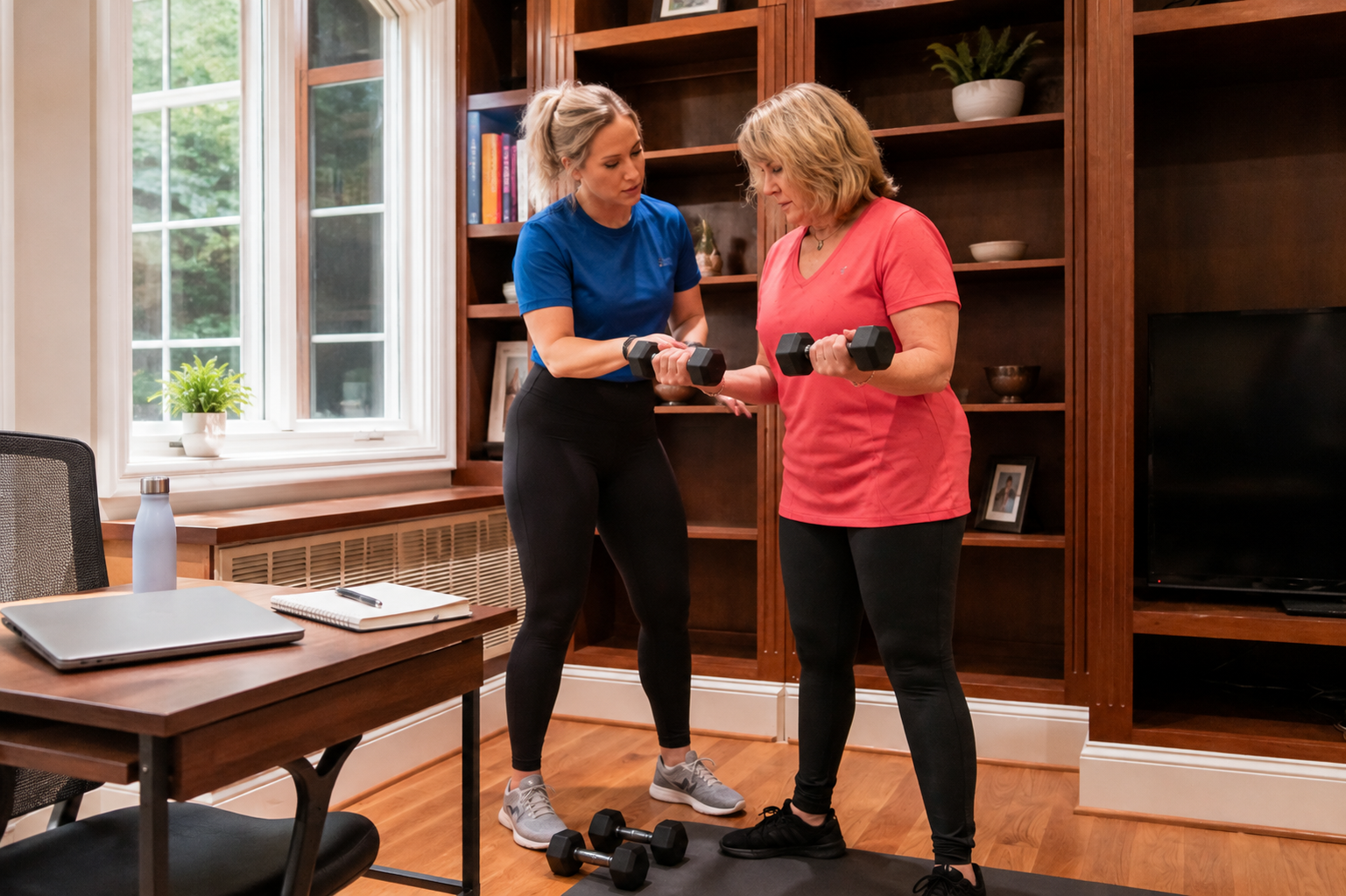
Equipment can be simple too. Depending on the program, a trainer may use resistance bands, dumbbells, kettlebells, sliders, a mat, bodyweight movements, or equipment you already own. The sophistication of a workout comes from the way it is programmed and coached, not from how many machines surround you.
Your house does not need to become a gym. It just needs to provide enough space for the workout you are doing that day.
Accountability Feels Different When the Appointment Comes to You
Motivation is unreliable during a busy season. Some days you may genuinely want to exercise. Other days, the couch is going to make a very persuasive argument.
That is where scheduled personal training provides structure.
Knowing that a trainer is arriving at a specific time removes some of the daily negotiation around whether the workout is going to happen. You are not waiting to see whether you “feel motivated” after work or hoping there is enough time left at the end of the day.
Your session already has a place on the calendar.
This is especially helpful during the first few weeks of rebuilding a routine. Once exercise becomes part of the rhythm of your week again, it stops feeling like something you are constantly trying to squeeze in.
Do Not Turn Your Reset Into Another All-or-Nothing Challenge
The post-summer reset can quickly become counterproductive if you approach it like punishment.
You do not need to erase every vacation meal, complete a 30-day extreme challenge, train seven days a week, or suddenly become a completely different person because September is approaching. That kind of intensity can feel exciting for a few days and exhausting shortly afterward.
A better reset starts with an honest assessment of where you are.
How many days can you realistically dedicate to structured training? Which part of your day tends to stay most predictable? What caused your previous routine to fall apart? Which workouts do you actually enjoy enough to repeat? What would make exercise feel easier to begin?
Those answers create a better foundation than an arbitrary challenge pulled from social media.
An in-home personal trainer can use those details to build something more personalized. Instead of starting with what an ideal fitness week is “supposed” to look like, you can start with your actual week.
Your Q4 Energy Strategy Starts Before Q4
Fourth quarter can feel like a sprint. Businesses are working toward year-end goals, schools are deep into the semester, holidays begin stacking onto weekends, and personal calendars often get more complicated rather than less.
Trying to build a brand-new fitness routine in the middle of that chaos is possible, but it is much easier when some of the groundwork is already in place.
Think of the next several weeks as your preseason.
You can establish your training days, learn which movements work well for you, improve your technique, identify realistic workout windows, and build familiarity with your routine before the holiday rush begins. You are creating a system while there is still room to adjust it.
For someone who wants to feel more energized through the end of the year, this can be far more useful than waiting for a burst of New Year's motivation.
A Post-Summer Reset Is Also a Chance to Change Your Goals
Maybe the fitness goal you set in January does not matter to you anymore. That is okay.
Eight months is enough time for priorities to change. You may care less about chasing a certain number on the scale and more about feeling stronger. Maybe you want enough endurance to enjoy a full day of travel without feeling wiped out. Perhaps your focus has shifted toward mobility, healthy aging, athletic performance, stress relief, or finally learning how to strength train with confidence.
Your fitness routine should evolve with your life.
That is another advantage of personalized training. A generic online plan usually cannot tell that your goals changed somewhere between spring and August. A trainer can.
Your post-summer reset is not necessarily about getting “back” to anything. It may be the right moment to move forward with a completely different goal.
Build a Routine That Can Survive the Holidays
The real test of a fitness routine is not whether it works during a perfect week. It is whether some version of it can continue when your week gets messy.
Fall is going to contain messy weeks.
There will be travel, late meetings, football weekends, school events, holidays, visitors, weather changes, and days when the schedule simply does not cooperate. A sustainable fitness plan needs enough flexibility to adjust without disappearing completely.
That may mean shifting a training day, shortening a workout, emphasizing mobility on a low-energy day, or changing the exercises based on the space available. It may also mean accepting that some weeks will look different from others.
Consistency is easier when flexibility is built into the plan from the beginning.
HOMEFIT's approach to personalized in-home personal training is designed around that reality. Fitness should be able to exist alongside work, family, travel, and the unexpected parts of everyday life rather than requiring all of those things to disappear first.
From Birmingham to Nashville, Fall Schedules Have One Thing in Common: They Fill Up
The details may look different depending on where you live, but the challenge is remarkably similar.
In Birmingham, Homewood, Hoover, Mountain Brook, and Vestavia Hills, busy professionals and families may be balancing work, school schedules, traffic, and fall activities. In Nashville, Franklin, Brentwood, Murfreesboro, and East Nashville, commutes and packed calendars can make adding another destination to the day feel unrealistic.
Clients in Huntsville and Madison may be balancing demanding professional schedules with family life, while someone in Georgetown, Texas or Medford, Oregon may have an entirely different daily routine. Along 30A and Santa Rosa Beach, summer travel patterns begin giving way to fall routines of their own.
The reason in-home personal training near you can work across all of those communities is simple: the training changes around the person instead of expecting every person to follow the same schedule.
A HOMEFIT trainer meets you where fitness fits.

The Best Fall Fitness Plan Is the One You Are Still Doing in December
It is easy to get excited about a reset. The harder part is creating something that does not disappear once the excitement wears off.
That is why your goal for August does not need to be dramatic. Establish a few dependable training windows. Focus on strength and movement that support your everyday life. Remove as many unnecessary barriers as possible. Get professional guidance when you need it, and give yourself permission to adjust the plan as the season changes.
If you can create a routine that works during an ordinary Tuesday in September, a hectic Thursday in October, and a holiday week in November, you have built something far more valuable than a short-term challenge.
You have built a fitness routine that actually belongs in your life.
Make This the Year You Do Not Wait Until January
Summer ending does not mean you need to panic about everything you did or did not accomplish. It simply gives you a natural opportunity to look ahead.
The next several months are going to get busy whether your fitness routine is ready for them or not. Starting now gives you a chance to rebuild strength, find a schedule that works, and create consistency before the end-of-year rush arrives.
HOMEFIT provides in-home personal training designed around your goals, schedule, fitness level, and available space. Instead of spending more of your day commuting to a gym, searching for equipment, or trying to figure out what workout to do, you can have personalized fitness coaching brought directly to the environment where it fits best.
So before you tell yourself you will start again in January, try something different this year.
Make August your reset.
Make fall your building season.
And head into the final months of the year with a fitness routine that is already working.
Ready for your post-summer reset? Find a HOMEFIT trainer near you and discover how personalized in-home personal training can fit into your schedule, your home, and your life. Contact us today to book a consultation and get a FREE yoga session or workout on us.